Friday, April 24, 2009

The Holden Torana Pictures


The Holden Torana Pictures
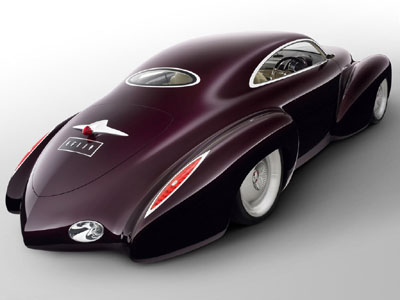
The Holden Torana was a car produced by General Motors–Holden's, the Australian subsidiary of General Motors (GM). The name comes from an Aboriginal word meaning "to fly". It had its origins in the British Vauxhall Vivas of the mid 1960s. The first Torana appeared in Australia in 1967, and the four-cylinder versions of the Torana became known as the Holden Sunbird in 1976. In 1979, the Torana was phased out, followed by the Sunbird in 1980.

The next generation of Toranas appeared in October 1969 and were available with either a four or six cylinder engine. The inline six had a capacity of 138 in. The six-cylinder cars had a longer wheelbase of four-cylinder models, a more aggressively styled slightly longer nose to accommodate the larger engine, and offered a choice of three and four-speed manual gearbox or a three-speed Trimatic automatic transmission. The Torana was Wheels magazine's Car of the Year for 1969.

Body styles were all new and available in either two or four doors, and were offered in S or SL trim. Bench or bucket front seats were also an option, along with disc front brakes. A more-powerful 161 in³ engine was made available soon after the model's release in the more upmarket SL and in the two-door sports model, the GTR, as a 2600S with a two-barrel Stromberg WW carburettor. Later in production, the 161ci engine was replaced with a larger 173ci version (badged as the '2850') which also made it into the last of the LC GTR cars in two-barrel form.

In 1970 the first genuine performance Torana, the GTR XU-1, was developed by Holden along with Harry Firth of the Holden Dealer Team for competition in popular Series Production racing series in Australia as well as in off-road rallying. However, the main purpose of the Torana GTR XU-1 was to keep Holden competitive against the big and powerful Ford Falcon GT-HO V8s in the Hardie-Ferodo 500 (Bathurst) endurance race that is considered to be the jewel in the crown of Australian motorsport.

Holden Car


Holden Car
GM Holden Ltd is an Australian automaker based in Port Melbourne, Victoria. The company was originally independent, but since 1931 has been a subsidiary of General Motors (GM). Holden has taken charge of vehicle operations for GM in Australasia and, on behalf of GM, holds partial ownership of GM Daewoo in South Korea. Over the years, Holden has offered a broad range of locally produced vehicles, supplemented by imported GM models. In the past, Holden has offered badge engineered Isuzu, Nissan, Suzuki and Toyota models in sharing arrangements, with Chevrolet, Daewoo and Opel-sourced models sold currently.

Holden bodyworks are manufactured at Elizabeth, South Australia, and engines are produced at the Fishermens Bend plant in Port Melbourne, Victoria. Historically, production or assembly plants were operated in all mainland states of Australia: Acacia Ridge, Queensland; Dandenong, Victoria; Mosman Park, Western Australia; Pagewood, New South Wales; and Woodville, South Australia. Until 1990, GM's New Zealand subsidiary Holden New Zealand operated a plant based in Trentham, with a plant in Petone running until 1984. The consolidation of car production at Elizabeth was completed in 1988, but some assembly operations continued at Dandenong until 1996. Although Holden's involvement in exports has fluctuated since the 1950s, the declining sales of large cars in Australia has led the company to look to international markets to increase profitability; in 2006, exports alone accounted for almost AU$1.3 billion in earnings.

GM Holden has issued a safety recall for Holden VE Commodore, Holden WM Statesman and Holden Caprice, involving around 13,000 vehicles. The recall is in relation to a potential issue regarding rear seat belt buckles. No customer cases have been reported but Holden is taking this action on advice from the relevant buckle supplier after the issue was detected during routine testing at the Holden Proving Ground.

The new Holden VZ Monaro has stirred up a bit of controversy among the car fanatics. With the new twin bonnet scoops on the front end of the vehicle some say its absolutely wonderful and others say that its horrible and in bad taste. However, I feel that the new bonnet scoops actually add a flare to the vehicle giving it a much more powerful look. Whether its good or bad, you will definitely get peoples attention when you drive by them. I feel that most people will appreciate the edgy design instead of looking at it as a flaw. Aside from the cosmetic changes, the new VZ Monaro features some great mechanical changes as well. Given the history of the Monaro I am hoping that this new update will do the name justice.

Tuesday, April 14, 2009

The Mazda Hybrid


The Mazda Hybrid
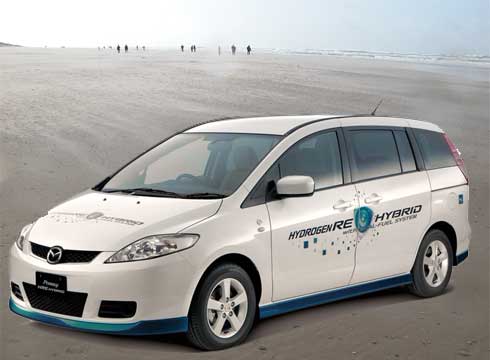
The Mazda 5 Premacy Hydrogen Hybrid runs on both gasoline and compressed hydrogen gas. Just pressing a button on the dashboard turns this minivan into a green vehicle and back again when more distance is needed. By introducing a bi-fuel hydrogen / gasoline ICE (internal combustion engine) Mazda is solving one of the key infrastructure issues revolving around just where does one buy hydrogen when so fuel stations are rolled out yet. This is one way to give manufacturers and distributors of hydrogen the incentive to roll out the hydrogen distribution network on a massive scale.
The hybrid unit and rotary engine are transversely mounted at the front of the car in a front-wheel drive layout with the high-voltage battery beneath the second row of seats (along with the gasoline tanki) and the hydrogen tank beside the last row of seats. This arrangement allows for a comfortable and roomy interior along with excellent driving performance and environmental benefits. Earlier versions of the bi-fuel mild hybrid system included regenerative braking, engine power assistance at low rpm's and stop-start capabilities, which have been carried over to the current Premacy as well.

Currently, the driving range of the Mazda 5 Premacy Concept on hydrogen is limited to around 124 miles before needing refueling. One advantage of using a rotary engine engineered to run on hydrogen is that it doesn't have the backfiring problems that typical internal combustion engines experience. Because the Mazda 5 Premacy's Renesis rotary engine has separate intake and combustion chambers, this makes it more ideal for burning hydrogen at lower temperatures.

Mazda Hydrogen Pictures


Mazda Hydrogen Pictures
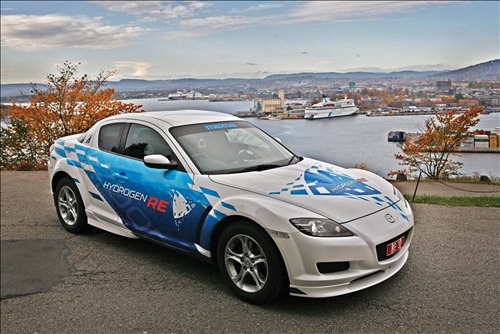
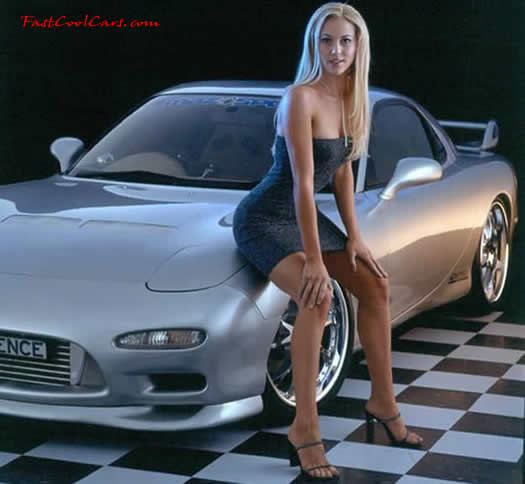
The world renowed Rotary engine on the Apart from being fast and good looking, Mazda RX-8 is renowned for having the Rotary engine which now may transform into a gas-hydrogen hybrid when the next generation, Mazda RX-9 (name speculation) will be available on the market. Since we’re used with power, I don’t think there are many readers that would buy him one knowing that on hydrogen he has 20% less horses to help him. Mazda hopes that’s just the city-mode, should include a gas switch in case you “need it”. In terms of styling, the next generation is said to borrow elements from the Mazda Taiki concept. We may have it by 2012, which is not bad at all.

Sporty crossover gains new engine option, plus styling and engineering enhancements. Launched in 2006 as a 2007 model, the Mazda CX-7 offers a blend of sports car verve and SUV practicality in a way that few other crossover vehicles can, and has garnered high praise by consumers and media as a true driver’s vehicle. “A key word in the development process of the 2010 CX-7 was refinement,” said Masashi Otsuka, Mazda Motor Corporation’s CX-7 program manager. “The vehicle we had to start with was already really good and well liked by consumers, so my team didn’t have to start over, but simply refine.” For 2010, the CX-7 continues to offer more of what has made it a success and adds characteristics of sophistication, sustainability and detail.

The Mazda Pictures


The Mazda Pictures
Mazda began as the Toyo Cork Kogyo Co., Ltd, founded in Japan in 1920. Toyo Cork Kogyo renamed itself to Toyo Kogyo Co., Ltd. in 1927. Toyo Kogyo moved from manufacturing machine tools to vehicles, with the introduction of the Mazda-Go in 1931. Toyo Kogyo produced weapons for the Japanese military throughout the Second World War, most notably the series 30 through 35 Type 99 rifle. The company formally adopted the Mazda name in 1984, though every automobile sold from the beginning bore that name. The Mazda R360 was introduced in 1960, followed by the Mazda Carol in 1962. Mazda Cosmo Sport

Beginning in the 1960s, Mazda put a major engineering effort into development of the Wankel rotary engine as a way of differentiating themselves from other Japanese auto companies. Beginning with the limited-production Cosmo Sport of 1967 and continuing to the present day with the RX-8, Mazda has become the sole manufacturer of Wankel-type engines mainly by way of attrition (NSU and Citroën both gave up on the design during the 1970s, and prototype efforts by General Motors never made it to production). This effort to bring attention to themselves apparently helped, as Mazda rapidly began to export its vehicles. Both piston-powered and rotary-powered models made their way around the world. The rotary models quickly became popular for their combination of good power and light weight when compared to piston-engined competitors that required a heavy V6 or V8 engine to produce the same power. The R100 and the famed RX series (RX-2, RX-3, and RX-4) led the company's export efforts.

During 1970, Mazda formally entered the North American market (Mazda North American Operations) and was very successful there, going so far as to create the Mazda Rotary Pickup (based on the conventional piston-powered B-Series model) solely for North American buyers. To this day, Mazda remains the only automaker to have produced a Wankel-powered pickup truck. Additionally, they are also the only marque to have ever offered a rotary-powered bus (the Mazda Parkway, offered only in Japan) or station wagon (within the RX-3 line).

Mazda's rotary success continued until the onset of the 1973 oil crisis. As American buyers (as well as those in other nations) quickly turned to vehicles with better fuel efficiency, the relatively thirsty rotary-powered models began to fall out of favor. Wisely, the company had not totally turned its back on piston engines, as they continued to produce a variety of four-cylinder models throughout the 1970s. The smaller Familia line in particular became very important to Mazda's worldwide sales after 1973, as did the somewhat larger Capella series.

The Jaguars Pictures


The Jaguars Pictures
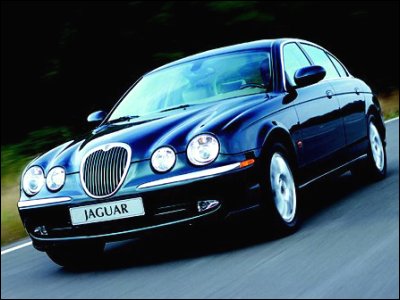
Jaguars for sale by Jaguar dealers and private owners. Find the exact Jaguars for sale that you're looking. Search the hottest Jaguars for sale instantly with our online database of luxury and exotic autos for sale. is the premier online auto classified marketplace for buyers seeking to find a new or used Jaguar for sale from dealers or individual owners.The C-XF concept car signals the onset of a new era for Jaguar. A stunning, four-door sports saloon which blends design purity with unmistakable dynamism, the C-XF, released at the 2007 North American International Auto Show, is a clear indication of the design direction that the next generations of Jaguar saloons will take.

From next year this cars will be made by Indian company tata motors. It has best skills of driving Tata motors want to integrate advanced radar software unto this car so you can drive it like a f16 it is true. Tata owns a company called TCS so it can possibly make any software including this one. Well a big combination Tata and Jaguar. Designed by the same teams that produced the award-winning Jaguar XK sports GT range in 2005, headed by Jaguar Director of Design Ian Callum and Head of Advanced Design Julian Thomson, the C-XF concept is a precursor to cars that will become recognised for their ground-breaking exterior looks and innovative interiors.

The C-XF’s design team took inspiration from some of Founder Sir William Lyons’ greatest cars, including the 1950 Mark VII and 1959 Mark 2 saloons. Their beautiful flowing lines were influenced by some of the great sporting Jaguars of the era including the XK120 and both display that extraordinary feeling of latent power that so signifies a Jaguar.

Chevrolet Car Pictures


Chevrolet Car Pictures
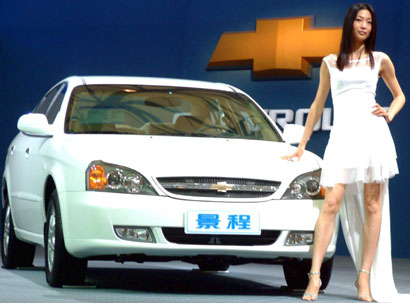
The Corvettes have a good history of a racing car. In a period of five years since their launch, the Corvette C5-R series had 35 victories in 55 races. The latecomer in the series to add more spice to the show is the 2007 Chevrolet Corvette Z06. The Z06 sports car combines the best attributes of the sixth generation Corvette with the modern technology. 2007 Chevrolet Corvette Z06 is the fastest and the most powerful car offered by Chevrolet in association with General Motors. The advanced features not only offer a new look to the Corvette but also contribute significantly to increase the power of this muscular car.

The exterior of the race car looks more appealing with the new coat of the atomic orange tint coat in place of the old Daytona Sunset Orange. More features to add to the attraction are the carbon-fiber front fenders and a magnesium engine cradle. The removable roof panel is offering the double advantage for an open-air driving and for adding a perfect look to the Chevrolet.